
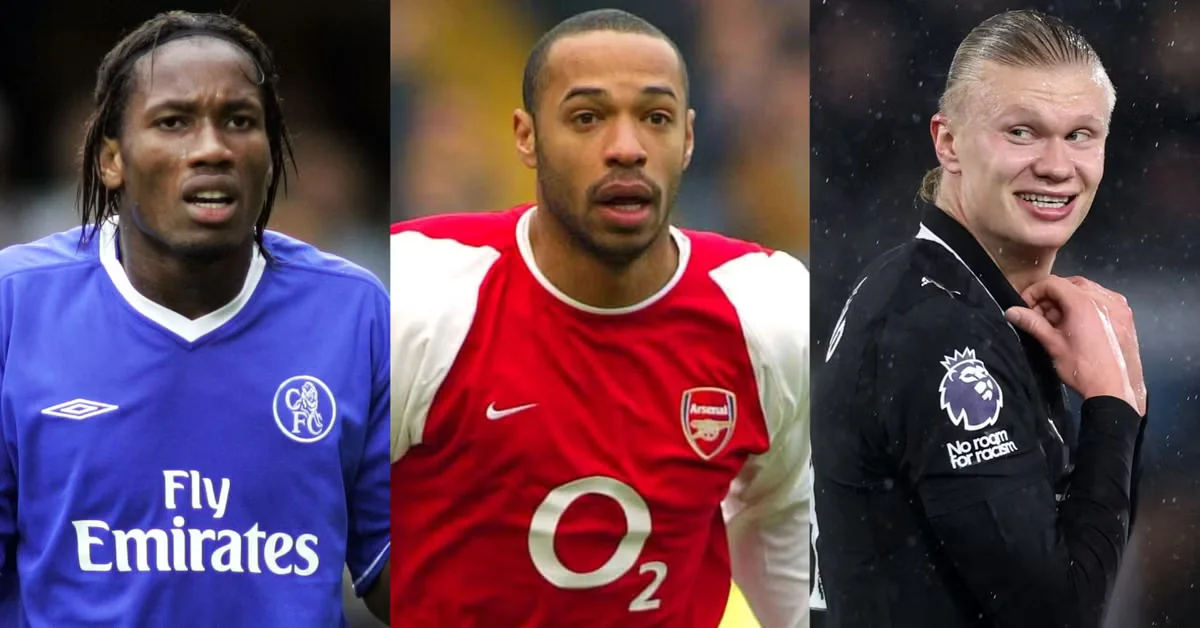
Attackers are the players we actually remember. They are the ones who decided the matches we replay in our heads: the finish at the far post, the run behind the defence, the last-minute winner that turned a season. The Premier League began in 1992, and its story has been shaped by forwards such as Alan Shearer, Thierry Henry, Wayne Rooney, Mohamed Salah, Sergio Agüero and Harry Kane.
The competition has changed around them. Manchester United have won 13 Premier League titles, Manchester City eight, Chelsea five and Arsenal four, with Arsenal’s latest title arriving in 2025/26 after a 22-year wait since 2003/04. Blackburn Rovers, Leicester City and Liverpool have also lifted the trophy.
Any list like this starts an argument. That is part of the fun. I have mixed peak ability, longevity, influence, creativity, scoring records, trophies and big-match moments rather than relying on goals alone. You may put Shearer above Henry, Kane above Rooney or Haaland much higher. Make your case.
How I Judged Them (and Why Attackers Spark the Biggest Arguments)
What I counted
“Attacker” is a broad term here. It includes centre-forwards, wide forwards, second strikers and creative forwards such as Dennis Bergkamp. That makes comparison imperfect, but it also reflects how the Premier League is actually played.
I considered a player’s best level, how long he sustained it, the quality of his output, his influence on winning teams and the number of matches in which he changed the outcome. The Premier League’s official all-time statistics provide the numerical foundation, while the judgement comes from watching what those players did with the ball.
What I deliberately left out
This is not a list of the 20 most decorated players, the 20 highest scorers or the 20 best forwards in world football. It is about Premier League impact.
That explains why Luis Suárez ranks highly despite having 69 league goals and why Cristiano Ronaldo’s position rests heavily on a short, extraordinary peak. It also explains why some outstanding players, including Teddy Sheringham and Fernando Torres, appear as honourable mentions rather than in the final 20.
Rank
| Rank | Player | Club(s) | Position | Key stat |
|---|---|---|---|---|
| 1 | Thierry Henry | Arsenal | Forward | 175 goals, four Golden Boots, two titles |
| 2 | Alan Shearer | Blackburn Rovers, Newcastle United | Striker | Record 260 goals |
| 3 | Wayne Rooney | Everton, Manchester United | Forward | 208 goals, five titles |
| 4 | Mohamed Salah | Chelsea, Liverpool | Wide forward | 257 goals, two titles |
| 5 | Sergio Agüero | Manchester City | Striker | 260 goals, five titles |
| 6 | Harry Kane | Tottenham Hotspur | Striker | 213 goals, second all-time |
| 7 | Cristiano Ronaldo | Manchester United | Wide forward | Three titles and 2007/08 peak |
| 8 | Luis Suárez | Liverpool | Forward | 69 goals in an exceptional peak |
| 9 | Ruud van Nistelrooy | Manchester United | Striker | 95 goals in 150 appearances |
| 10 | Didier Drogba | Chelsea | Striker | 104 goals, four titles |
| 11 | Robin van Persie | Arsenal, Manchester United | Striker | 144 goals, 2012/13 title winner |
| 12 | Ian Wright | Arsenal, West Ham United | Striker | 113 goals in 213 appearances |
| 13 | Andy Cole | Newcastle United, Manchester United, others | Striker | 187 goals |
| 14 | Robbie Fowler | Liverpool, others | Striker | 163 goals |
| 15 | Michael Owen | Liverpool, others | Forward | 150 goals and explosive early peak |
| 16 | Dennis Bergkamp | Arsenal | Forward | 87 goals, three titles |
| 17 | Eric Cantona | Leeds United, Manchester United | Forward | 70 goals, five titles |
| 18 | Erling Haaland | Manchester City | Striker | Fastest to 100 Premier League goals |
| 19 | Son Heung-min | Tottenham Hotspur | Wide forward | 127 goals and 2021/22 Golden Boot |
| 20 | Jermain Defoe | Tottenham Hotspur, others | Striker | 162 goals |
How to read the table
The ranking is not a league table. A player can have fewer goals and still have a stronger overall case because he created more, carried a team further or reached a higher peak.
That is especially important when comparing a traditional striker with a wide forward. Salah, Ronaldo and Son often began from the flank, while Henry and Rooney moved between roles. Their jobs changed, but their influence remained attacking.
Why a goals column can never be the whole answer
Goals measure the final touch. They do not always show the movement that created the chance, the pass before the assist or the defender dragged out of position.
A forward is often the key that opens the lock even when someone else turns the handle. That is why Bergkamp, Cantona and Suárez belong in this conversation.
1-4: The Everest Tier
Thierry Henry: the most complete attacker the league has seen
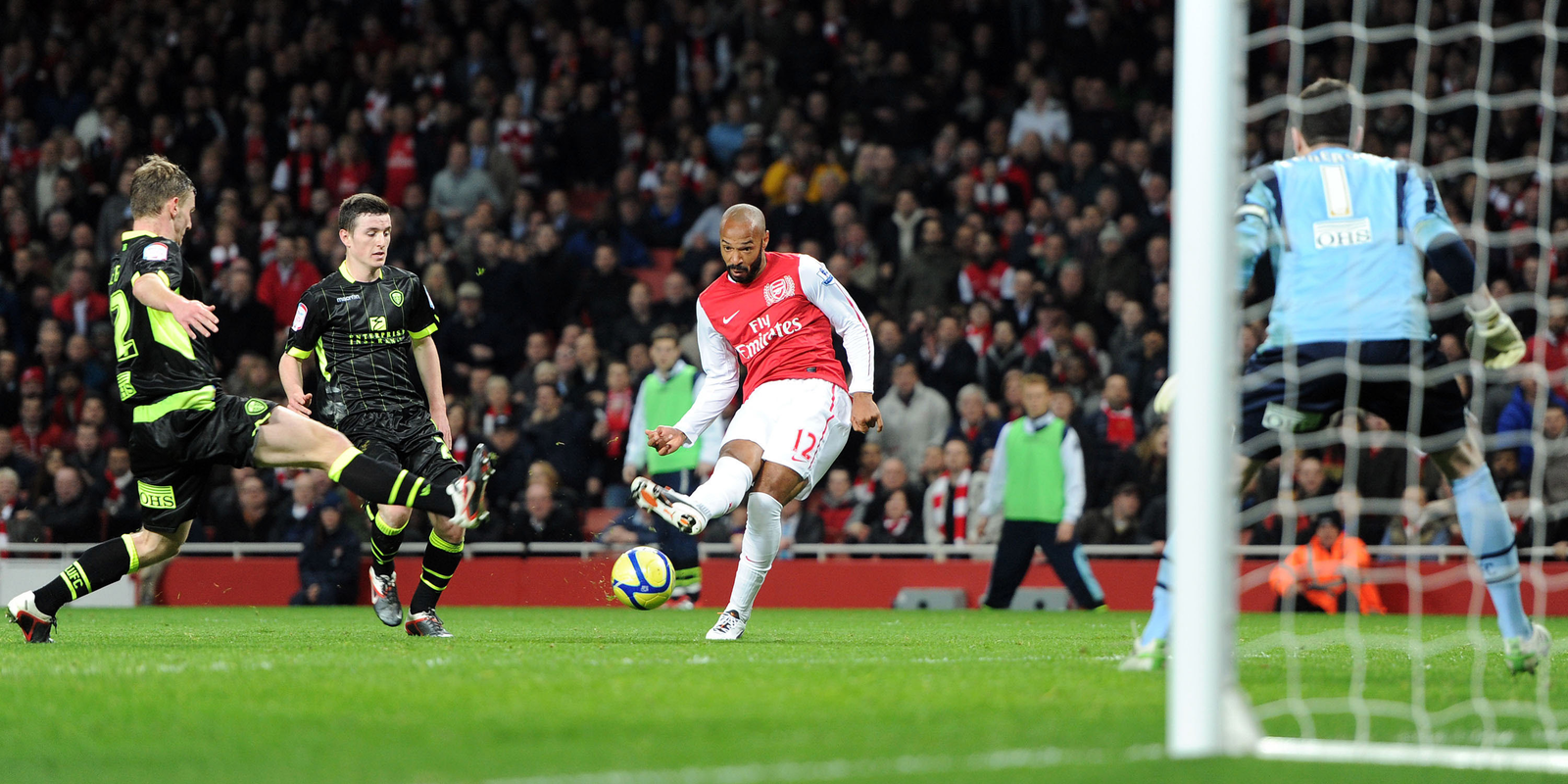
Henry could beat a defender, create a chance, finish from distance and lead a counter-attack almost by himself. His long stride made him look unhurried, yet he could still disappear beyond a defensive line before centre-backs had turned around.
He scored 175 Premier League goals in 258 appearances and won two titles with Arsenal. Four Golden Boots, a joint record, underline his consistency. So does his role in the unbeaten 2003/04 Invincibles season.
Henry’s case is not just statistical. He changed the visual language of attacking football in England. He was a striker who could begin on the left, drift centrally and still arrive in the box like a classic number nine.
The numbers behind the case
Henry’s numbers are strong, but the balance of goals and creativity makes him different. He could finish like a penalty-box predator and pass like a playmaker.
That combination gives him the top spot. For me, Henry reached the best blend of speed, technique, imagination and end product in Premier League history.
Alan Shearer: 260 goals and a record that has lasted 30 years
Shearer remains the Premier League’s all-time leading scorer with 260 goals in 441 appearances. He won the title with Blackburn Rovers in 1994/95, then became the defining figure of Newcastle United’s modern history.
His game was built on power and precision. He could score with either foot, attack crosses, strike free-kicks and finish penalties without fuss. There was no wasted movement. Shearer operated like a machine built for the six-yard box.
The strongest argument for ranking him first is simple: nobody has scored more. The strongest argument against it is that Henry offered more variety. That is the line between these two greats.
Wayne Rooney: the wrecking ball who did everything
Rooney scored 208 goals in 491 appearances and won five Premier League titles. Yet his goal total only tells half the story.
He could lead the line, play behind a striker, drift wide, press defenders and deliver a long pass from deep. Rooney attacked matches with the energy of a midfielder and the aggression of a centre-forward. He was not simply a finisher; he was often the engine of the attack.
His overhead kick against Manchester City remains one of the division’s great goals, but his wider value came from adaptability. Rooney could change his game as his pace faded and still remain useful.
Mohamed Salah: the modern standard-setter
Salah has 193 Premier League goals in 328 appearances and won two titles with Liverpool. His 2024/25 campaign was extraordinary: 29 goals and 18 assists in 38 appearances, giving him 47 goal involvements.
That equalled the single-season record set by Andrew Cole in 1993/94 and Alan Shearer in 1994/95. Salah also became the first player to win the Golden Boot, Playmaker award and Player of the Season award in one campaign. His fourth Golden Boot equalled Henry’s record.
He left Liverpool at the end of 2025/26, making his final Anfield appearance on 24 May 2026. Salah’s value comes from doing winger’s work with striker’s numbers.
5-8: The Killer Instinct Group
Sergio Agüero: the most lethal per minute
Agüero scored 184 goals in 275 appearances and won five Premier League titles. His defining moment came at 93:20 against Queens Park Rangers in May 2012, when his goal delivered Manchester City’s first Premier League title.
He was short, sharp and devastating around the penalty area. Agüero needed very little space. One touch could move the ball away from a defender; the next could send it into the corner.
He also combined elite movement with remarkable efficiency. For a striker, he was almost impossible to keep quiet for 90 minutes.
Harry Kane: the goals without the medals
Kane is second on the all-time scoring list with 213 goals in 320 appearances. He has never won a Premier League title, which makes his position one of the most interesting on this list.
His finishing was outstanding, but his evolution made him special. Kane learned to drop deep, receive the ball and release runners with passes that belonged to a number ten. He could be the scorer and the supplier in the same move.
The missing title affects his legacy, but it should not erase the quality of his individual career. Kane’s scoring record is too large to dismiss.
Cristiano Ronaldo: the peak that lasted two blinding seasons
Ronaldo made 236 Premier League appearances and won three titles with Manchester United. His 2007/08 season remains one of the most complete individual campaigns in the competition’s history: Premier League winner, Champions League winner, Premier League Player of the Season and Ballon d’Or winner.
His Premier League case rests on peak rather than longevity. Ronaldo became more of a goal-focused forward during those two seasons, attacking space with speed, power and a growing confidence in front of goal.
He left England before building the same league volume as Shearer, Rooney or Salah. But at his best, he was a storm that defenders could only try to survive.
Luis Suárez: the most frightening three years of the modern era
Suárez scored 69 Premier League goals, all for Liverpool between 2011 and 2014. That total looks modest beside the players above him, but totals can hide a volcano.
His 2013/14 season remains the clearest example. Suárez was inventive, aggressive and completely unpredictable. He could beat a man, shoot from awkward angles, create chances and turn a broken attack into a goal.
Liverpool came close to the title that season, and Suárez was the central force behind the challenge. His peak was one of the most unplayable three-year spells the Premier League has seen.
9-12: Predators and Big-Game Men
Ruud van Nistelrooy: the purest finisher
Van Nistelrooy scored 95 goals in 150 appearances for Manchester United and added 14 assists. His strike rate was exceptional because he treated the penalty area like a private workshop.
He did not need to dominate a match to decide it. A small movement across the near post, a delayed run or a loose ball was enough. His finishing looked simple because his positioning was so precise.
Didier Drogba: the man for the final
Drogba scored 104 goals in 254 appearances and won four Premier League titles with Chelsea. His physical power made him difficult to handle, but his biggest strength was his ability to appear when the match carried the most pressure.
He had a notable record of scoring in cup finals and became a symbol of Chelsea’s rise. Drogba could hold the ball, bring teammates into play, win aerial duels and finish important chances.
His league numbers do not fully capture his influence. Drogba’s reputation was forged under bright lights.
Robin van Persie: the left foot that won a title
Van Persie scored 144 goals in 280 appearances and won the Premier League with Manchester United in 2012/13.
His left foot was elegant but severe. He could bend the ball into the far corner, volley across his body or control a difficult pass in one movement. At Arsenal, he became a complete forward. At United, he supplied the goals that helped deliver the title.
The volley against Aston Villa is the obvious image, but his consistency across the season mattered more.
Ian Wright: the late bloomer who broke records
Wright scored 113 goals in 213 appearances. He did not play top-flight football until his late twenties, yet he still became Arsenal’s record goalscorer before Henry passed him.
That tells you something about his hunger and natural ability. Wright played with a spring-loaded sense of movement. He attacked space quickly, celebrated every goal fully and made defenders uncomfortable through constant pressure.
His route to the top was unusual. His impact was not.
13-16: Prolific, Underrated and Brilliant
Andy Cole: the striker who made 187 look quiet
Cole scored 187 goals in 414 appearances, a total that puts him among the greatest scorers in Premier League history.
His movement often went underappreciated because he made difficult actions look ordinary. Cole could stretch a defence, combine with a partner and finish from close range. His partnership with Dwight Yorke helped Manchester United win the 1998/99 treble.
He was not always the most fashionable name, but the numbers and medals make his case sturdy.
Robbie Fowler: the most natural finisher of his generation
Fowler scored 163 goals in 379 appearances. At Liverpool, he earned the nickname “God” from supporters who saw a forward with an instinctive understanding of the goal.
His finishing was quick and economical. Fowler often seemed to know where the ball would fall before everyone else. His movement, composure and left-footed strikes made him one of the most feared young forwards of the 1990s.
Michael Owen: the teenager who terrified defenders
Owen scored 150 goals in 326 appearances. His early Liverpool years were built on acceleration, timing and a calmness that seemed unusual for a teenager.
He could run behind a defence in three steps and finish before a defender had time to recover. His pace gave him a threat that changed how opponents defended.
Injuries later altered his trajectory, but they do not erase the brilliance of his early peak.
Dennis Bergkamp: the artist who never needed to sprint
Bergkamp scored 87 goals in 315 appearances and won three Premier League titles with Arsenal.
His influence lived in the spaces between statistics. Bergkamp’s first touch could remove a defender from the game. His passes arrived with disguise, weight and perfect timing. The goal against Newcastle in 2002 remains an enduring example of balance and imagination.
He proves that attacking greatness does not always arrive at full speed. Sometimes it pauses, looks up and chooses the better option.
17-20: Icons, Records and the Current Era
Eric Cantona: the catalyst
Cantona scored 70 goals in 156 Premier League appearances and won five titles across Leeds United and Manchester United.
His greatest contribution was cultural and tactical. Cantona gave United confidence, control and a focal point during the early years of Premier League dominance. He could score, create and make the team believe it belonged at the top.
He was not the league’s leading scorer, but he helped establish the standards that others followed.
Erling Haaland: the record-breaker in a hurry
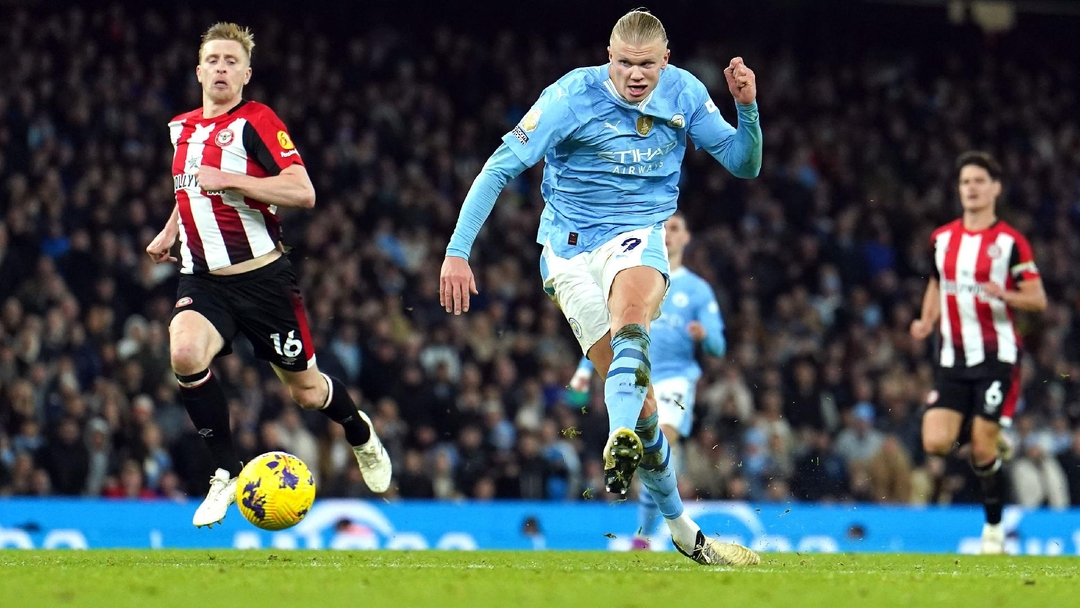
Haaland became the fastest player to reach 100 Premier League goals, doing so in 111 matches against Fulham on 2 December 2025. As of 5 September 2026, he had 115 goals in 135 appearances and two titles.
The Premier League’s official record confirms that he beat Shearer’s previous mark of 124 matches. BBC Sport also noted his extraordinary scoring rate.
Haaland ranks 18th because longevity still matters. His ceiling may be higher than this position, but the rest of the story has not yet been written.
Son Heung-min: the two-footed anomaly
Son scored 127 goals in 331 appearances and added 71 assists. He shared the 2021/22 Golden Boot with Salah after both players finished on 23 goals.
His rare quality was the ability to finish comfortably with either foot. That forced defenders into bad choices: show him inside and risk the right foot, or show him outside and risk the left.
Son also carried the ball over long distances and made Tottenham dangerous in transition. His goals were often clean, fast and beautifully struck.
Jermain Defoe: the most underrated goalscorer of the modern era
Defoe scored 162 goals in 496 appearances. He spent much of his career moving between clubs, which may have reduced the attention given to his overall achievement.
His finishing remained remarkably reliable. Defoe could score from the edge of the box, attack a through-ball or produce a first-time finish before defenders reacted.
A total of 162 goals across 496 appearances represents sustained excellence. He belongs in this list because he kept finding the net across changing teams, managers and systems.
Table 2: The 20 Greatest Premier League Attackers, The Full Ranking
| Rank | Player | Position | Premier League appearances | Premier League goals | Premier League titles |
|---|---|---|---|---|---|
| 1 | Thierry Henry | Forward | 258 | 175 | 2 |
| 2 | Alan Shearer | Striker | 441 | 260 | 1 |
| 3 | Wayne Rooney | Forward | 491 | 208 | 5 |
| 4 | Mohamed Salah | Wide forward | 442 | 257 | 2 |
| 5 | Sergio Agüero | Striker | 275 | 184 | 5 |
| 6 | Harry Kane | Striker | 320 | 213 | 0 |
| 7 | Cristiano Ronaldo | Wide forward | 236 | 103 | 3 |
| 8 | Luis Suárez | Forward | 133 | 82 | 1 |
| 9 | Ruud van Nistelrooy | Striker | 150 | 95 | 0 |
| 10 | Didier Drogba | Striker | 254 | 104 | 4 |
| 11 | Robin van Persie | Striker | 280 | 144 | 1 |
| 12 | Ian Wright | Striker | 213 | 113 | 0 |
| 13 | Andy Cole | Striker | 414 | 187 | 0 |
| 14 | Robbie Fowler | Striker | 379 | 163 | 0 |
| 15 | Michael Owen | Forward | 326 | 150 | 0 |
| 16 | Dennis Bergkamp | Forward | 315 | 87 | 3 |
| 17 | Eric Cantona | Forward | 156 | 70 | 5 |
| 18 | Erling Haaland | Striker | 135 | 115 | 2 |
| 19 | Son Heung-min | Wide forward | 331 | 127 | 0 |
| 20 | Jermain Defoe | Striker | 496 | 162 | 0 |
What the second table shows
The table shows why this debate cannot be settled by one column. Kane has more goals than Henry, but Henry ranks higher because of his complete attacking influence and trophy-winning peak. Defoe has more goals than Cantona, but Cantona changed Manchester United’s early Premier League era.
How to argue about it properly
Start with the player’s role, then consider the team around him. Compare output, but also compare what the player was asked to do.
A fair argument can disagree with the order. It should not ignore the context.
The Honourable Mentions
Unlucky to miss out
Teddy Sheringham scored 146 Premier League goals and brought intelligence, link play and longevity to several strong teams. Fernando Torres scored 85 goals in 212 appearances with 28 assists and produced an outstanding peak at Liverpool.
Both had credible cases. So did Jamie Vardy, whose title-winning 2015/16 season remains one of the great individual stories in Premier League history.
The current generation knocking on the door
Haaland is already inside the top 20, but his final position could rise quickly. Other current attackers will need more seasons before their cases become complete.
That is the difficulty of ranking active players. You are judging a moving picture, not a finished portrait.
Goals Per Appearance: Who Was Actually the Most Lethal?
The efficiency argument for Agüero, Henry and Van Nistelrooy
Using the verified totals above, Agüero’s 184 goals in 275 appearances works out at roughly 0.67 goals per appearance. Shearer’s 260 in 441 is roughly 0.59, while Henry’s 175 in 258 is roughly 0.68.
Van Nistelrooy’s 95 in 150 is roughly 0.63. These are simple calculations from total goals divided by appearances, not a minutes-based measure.
Why minutes per goal can flatter as well as reveal
A substitute may have a strong minutes-per-goal figure because he enters matches against tired defenders. A player who starts every week may carry more responsibility but appear less efficient.
That is why totals, starts, minutes, role and team quality should sit together. One ratio can point to a truth, but it cannot tell the whole story.
How the 2026/27 Season Changes the Debate
Haaland’s chase for 260
Haaland has already broken the fastest-to-100 record. The larger question is whether he can reach Shearer’s 260.
At 115 goals in 135 appearances as of 5 September 2026, his start is extraordinary. But maintaining that level across injuries, tactical changes and the physical demands of several more seasons is a different test.
Where the current crop fits
Salah has completed his Premier League career, while Haaland remains in the middle of his. That difference matters. Salah’s legacy can now be judged as a finished body of work; Haaland’s cannot.
The next few seasons may change the order, but they cannot yet change the evidence already created by Henry, Shearer, Rooney and the rest.
Final Thoughts
The greatest Premier League attacker depends on what you value most. If you want the record, Shearer leads. If you want the most complete peak, Henry has the strongest case. If you want efficiency, Agüero and Van Nistelrooy stand out. If you want modern consistency, Salah belongs near the top. My choice is Henry because he combined elite scoring with creation, movement, speed and control better than anyone else in the competition.
FAQs
Who has scored the most Premier League goals?
Alan Shearer holds the record with 260 goals in 441 appearances. He scored for Blackburn Rovers and Newcastle United and remains the benchmark for long-term Premier League scoring.
Who is the greatest Premier League striker ever?
There is no objective answer, but Thierry Henry has the strongest all-round case. Shearer has the better scoring record, while Agüero has an exceptional efficiency and trophy record.
Was Thierry Henry better than Alan Shearer?
That depends on the criteria. Shearer was the more prolific scorer, but Henry offered more as a creator, dribbler and wide-to-central attacker. That is why Henry ranks first in this list.
Who has the best goals-per-game record among the players listed?
Using the supplied totals, Henry’s 175 goals in 258 appearances works out at roughly 0.68 goals per appearance, narrowly ahead of Agüero’s roughly 0.67. The calculation uses appearances rather than minutes.
Did Harry Kane ever win the Premier League?
No. Kane scored 213 Premier League goals in 320 appearances but did not win the title during his Tottenham career.
Is Erling Haaland going to break Alan Shearer’s record?
He has a realistic chance, but it is not guaranteed. Haaland reached 100 goals faster than anyone else, yet he still needs 145 more goals to match Shearer’s 260. Injuries, form and career length will matter.
Who scored the most goals in a single Premier League season?
Haaland’s 2022/23 campaign produced a record 36 goals. That remains one of the clearest examples of his extraordinary scoring level.
Was Mohamed Salah the best winger or a forward?
Salah began many matches from the right but played as an inside forward, attacking the box like a striker. Calling him only a winger understates his goal threat and his responsibility in Liverpool’s attack.
Why is Luis Suárez ranked so highly with only 69 Premier League goals?
Suárez’s Premier League career was shorter than those of the leading scorers, but his peak was exceptional. His 2013/14 season showed a player who could score, create and unsettle every type of defence.
Why is Cristiano Ronaldo not higher?
Ronaldo’s peak was outstanding, especially in 2007/08, and he won three Premier League titles. He ranks seventh because his Premier League period was shorter than the careers of players such as Shearer, Rooney, Salah and Kane.
Can a creative forward like Dennis Bergkamp belong in a list of attackers?
Yes. Bergkamp was not judged only as a goalscorer. His first touch, passing, movement and chance creation made him one of Arsenal’s most important attacking players.
Which attacker was the most underrated?
Jermain Defoe has a strong claim. His 162 goals in 496 appearances show remarkable consistency, yet he is often discussed less than players with shorter, more dramatic peaks.